Toward General-Purpose Embodied Intelligence
We are witnessing the beginning of an exponential curve in embodied intelligence.
Humans can step into an unfamiliar environment, understand an open-ended goal, and manipulate novel objects and tools in real time. Endowing robots with this same physical generality has been a central pursuit for decades. While foundation model pretraining has recently shifted the field from task-specific controllers toward generalist policies, pretraining in most existing systems still serves only as an initialization for downstream fine-tuning—not a direct source of open-world competence.
We introduce WALL-OSS-1.0, our latest robot foundation model and a new starting point toward general-purpose embodied intelligence. Without task-specific demonstrations or fine-tuning, a single pretrained policy follows open-ended instructions and acts in real time across unfamiliar objects, tools, layouts, and embodiments—from using novel tools and coordinating both arms to completing long-horizon tasks and recovering from errors, as illustrated below. This breadth extends to an open-ended real-robot evaluation, where WALL-OSS-1.0 achieves a 55.1% zero-shot success rate across 312 unique tasks freely chosen by evaluators.
What Does It Take to Build General-Purpose Embodied Intelligence?
We believe the answer lies in two fundamental capabilities: the intelligence to understand the world and the ability to interact with it effectively. A capable vision-language-action (VLA) model must connect these capabilities, translating visual understanding and instruction reasoning into precise, reliable physical actions in real time.
Imagine a robot entering an entirely new environment, encountering unfamiliar objects, and receiving instructions it has never seen before. To act effectively, it must draw on accumulated experience to understand the situation and determine how to act. Our goal for pretraining is to build this connection between understanding and action, so that knowledge and skills learned across diverse experiences can be applied together in unfamiliar situations.
Realizing this vision requires coordinated design of models and data: a unified architecture that connects semantic understanding with efficient, reliable physical control, and large-scale robot experience that captures the diversity of the physical world. Diverse supervision and rigorous data quality control are essential to turn that experience into generalizable behavior.
These principles guide the development of WALL-OSS-1.0 across four key aspects:
Native VLA foundation. We build a natively unified foundation for vision, language, and action, bringing multimodal understanding and embodied behavior into a shared learning framework. By jointly modeling language and action while leveraging diverse forms of supervision, we aim to develop models that can interpret complex contexts, understand task semantics, and connect high-level understanding with physical execution.
Generalized, efficient, and precise action generation. A general-purpose VLA must not only understand what to do, but also execute it effectively. We scale heterogeneous robot experiences across diverse tasks, environments, and manipulation behaviors, enriched with fine-grained language supervision and targeted corrective data. Building on this foundation, we develop action generation mechanisms that combine broad zero-shot generalization with efficient, precise continuous control.
Adapt to diverse data and deployment needs. General-purpose robot learning must accommodate heterogeneous data sources and practical deployment constraints. We develop WALL-OSS-1.0 as a family of models that supports different supervision settings, action modeling approaches, and inference requirements, enabling flexible trade-offs between model capability, computational efficiency, and deployment needs.
Demonstrate real capability. Ultimately, progress in VLA modeling must translate into meaningful real-world capabilities. We evaluate WALL-OSS-1.0 through real-robot and simulation benchmarks as well as real-world deployments, examining generalization to unseen tasks and environments alongside the speed, fluency, and closed-loop reliability of physical execution. These evaluations help establish how advances in unified VLA pretraining translate into practical embodied intelligence.
A Unified Foundation for General-Purpose Embodied Intelligence
General-purpose embodied intelligence requires a model that can do more than understand the world and then learn to act. It demands a foundation in which perception, language, and physical interaction are deeply connected from the beginning of training.
The success of large language models has demonstrated the power of general-purpose pretraining: by learning from diverse data through a unified training objective, a single foundation model can acquire broad capabilities that generalize across tasks and contexts. We believe the next generation of embodied foundation models should embrace the same principle, extending this unified learning paradigm beyond language and vision to physical action.
Today, a common approach to building VLA models is to start from a pretrained vision-language model (VLM) and introduce robotic action capabilities through subsequent post-training. While this brings powerful visual and linguistic knowledge into robotics, the model’s foundational representations are largely established before it encounters physical action. We envision a more general and scalable paradigm, where vision, language, and action are treated as native modalities of a single foundation model, learned jointly rather than connected only through downstream adaptation.
With WALL-OSS-1.0, we take a step toward this vision through native VLA pretraining. Starting from Qwen3.51 base, we jointly incorporate language, vision-language, and robot-action data into a unified autoregressive training process. This allows robot experience to shape the model’s multimodal representations alongside visual and linguistic knowledge, establishing a shared foundation for understanding, reasoning, and physical interaction.
Our ambition goes beyond enabling a VLM to generate robot actions. We aim to build a truly unified multimodal foundation, where actions are not merely outputs to be predicted, but also experiences to be understood, interpreted, evaluated, and improved upon.
A Shared Foundation for Vision, Language, and Action
At the core of WALL-OSS-1.0 is a unified autoregressive architecture that models language and robot actions within a shared sequence space.
Starting from Qwen3.5 base, we integrate a visual encoder, multimodal projection interface, and discrete action vocabulary into a shared backbone. Images and video frames are mapped into the model’s representation space, while language instructions, robot states, execution histories, and reference demonstrations provide different forms of contextual information.
To bring diverse robot experience into this shared framework, we convert continuous trajectories into compact sequences of discrete action tokens using an improved version of our previously developed X-Tokenizer2. Different robot embodiments—from single arms and dual arms to systems with mobile bases—have distinct control structures and action dimensions. Our action representation accommodates these differences while preserving the fine-grained motion information needed for physical control. This provides a shared action language across embodiments, allowing heterogeneous robot trajectories to participate in unified pretraining as structured sequences, much like language.
This design enables language, vision-language, and robot-derived tasks to share a common next-token prediction objective. The visual encoder, projection interface, and backbone are jointly optimized during unified pretraining, while the pretrained action tokenizer remains frozen.3
Crucially, this shared framework allows robot experience to influence the development of multimodal representations rather than being introduced only after vision-language pretraining. Visual and language tasks provide broad knowledge about objects, scenes, spatial relationships, and instructions, while action-related tasks connect this knowledge to physical motion and manipulation.
The result is a unified learning foundation that brings perception, semantics, and embodied behavior into a common modeling framework.
Scaling Action Modeling
Can action modeling benefit from sustained increases in model capacity, training data, and computation? To isolate this question, we trained a family of autoregressive Transformers to predict discrete action sequences, keeping the action representation and learning objective fixed. The study spans models from 10M to 1B parameters and more than four orders of magnitude in estimated training compute.
As compute increases, the best validation loss across the tested configurations continues to decrease. Individual models eventually show diminishing returns, while larger models extend the improving frontier. This makes scaling a joint problem: additional training is most effective when accompanied by enough model capacity to absorb it.
The empirical lower envelope tracks the lowest interpolated CE loss across model curves at each compute budget. A power-law fit closely follows this frontier over the measured range, revealing a regular relationship between training computation and action-sequence prediction quality.
These controlled action-modeling results provide an empirical motivation for scaling native VLA pretraining. Discrete actions form a learnable sequence space with sustained returns to scale. In Stage 1, we bring robot experience into the core pretraining process alongside language and vision, building a shared foundation whose action capabilities can develop with its multimodal representations. Realizing that foundation also requires richer supervision than action prediction alone.
Beyond Imitation: Learning to Understand, Evaluate, and Correct Actions
A unified action representation makes joint pretraining possible. But what the model learns from robot experience is just as important as how that experience is represented.
Conventional behavior cloning primarily reduces robot learning to a fixed observation-to-action mapping. However, building a truly general-purpose VLA foundation calls for a much broader learning paradigm. Just as large language models develop versatile capabilities by learning from diverse contexts and tasks within a unified sequence modeling framework, we envision VLA pretraining that goes beyond action imitation to embrace the full richness of embodied experience. Robot trajectories contain not only actions to reproduce, but also task semantics, temporal dependencies, physical consequences, and opportunities for evaluation and correction.
To this end, we design a rich collection of training recipes that span diverse contextual settings and prediction objectives. By varying both the information provided to the model and what it is asked to predict, we enable vision, language, and action to interact in multiple ways within the same autoregressive framework. Rather than simply training multiple capabilities in a shared model, these recipes aim to foster deeper native alignment across modalities, allowing the model to learn generalizable relationships between perception, semantic understanding, and physical behavior.
Learning to act from diverse contexts. We train the model to predict actions from long execution histories, interleaved observations and actions, and reference demonstrations. In particular, in-context learning tasks require the model to infer intended behavior from visual demonstrations and apply it to the current scene without an explicit task instruction. These training formats encourage the model to leverage contextual information rather than relying on a fixed observation-to-action mapping.
Connecting physical motion with semantic understanding. We introduce complementary tasks that associate action tokens with visual observations, numerical trajectories, and natural-language descriptions. The model learns to recognize actions from videos, describe encoded motions, predict physical quantities, and interpret manipulation trajectories at the semantic level. These objectives establish connections between what the robot observes, what an action means, and how that action is physically executed.
Learning to evaluate and improve actions. Beyond generating trajectories, we train the model to assess candidate actions, compare alternative behaviors, identify potential execution failures, and revise incorrect action proposals. Preference supervision, synthetic action perturbations, and human takeover trajectories provide complementary signals for action evaluation and correction.
Together, these tasks expand the role of robot data beyond imitation. Actions become not only prediction targets, but also contextual evidence, objects of semantic understanding, and candidates for evaluation and correction.
This is a critical step toward a foundation model that can do more than execute learned behaviors: one that can use contextual experience to interpret, select, and refine physical actions.
Balancing Broad Intelligence and Embodied Experience
A native VLA foundation must develop strong physical interaction capabilities without sacrificing the broad knowledge and reasoning abilities that make multimodal foundation models powerful.
To achieve this, we combine large-scale language and vision-language pretraining data with diverse robot-derived supervision in a unified training mixture. General multimodal data covers a wide spectrum of capabilities, including image and video understanding, visual grounding, spatial reasoning, document understanding, mathematics, code, and tool use. Robot-derived data complements this knowledge with action prediction, motion understanding, trajectory evaluation, and corrective behavior.
Specifically, our unified pretraining mixes three complementary types of data: VL Pretraining, covering broad language and vision-language understanding; Action, focusing on discrete robot-action prediction; and Action VL, connecting robot actions with semantic understanding through motion descriptions, trajectory reasoning, action evaluation, and correction. This balance reflects a central principle of our training strategy: general intelligence and embodied capabilities should reinforce one another. Broad language and visual knowledge provides the semantic foundation for understanding unfamiliar tasks and environments, while diverse robot experiences ground that knowledge in physical behavior.
Preserving General Intelligence Through Unified Training
Learning to act while preserving general capabilities is a central goal of unified training. The VLA–VLM benchmark suite4 reports substantial declines from the original backbones for several VLA models. We address this challenge by jointly training on language, vision-language, and robot-action tasks, maintaining general supervision throughout action learning. On the suite’s eight benchmarks, our completed Stage 1 model achieves 79.2% versus 79.4% for its base model, averaging the primary scores equally under matched native templates. This near-base performance supports the effectiveness of unified training in preserving general capabilities while incorporating embodied experience.
Through native VLA pretraining, WALL-OSS-1.0 takes a step toward a more unified foundation for embodied intelligence, in which understanding and action are learned together, and the same model can use its knowledge to interpret, generate, evaluate, and refine robot behavior.
This foundation sets the stage for the next challenge: scaling diverse robot experience into precise, efficient, and broadly generalizable physical interaction.
From Unified Intelligence to Capable Physical Action
A general-purpose VLA must translate its understanding of the world into actions a robot can execute. Understanding a scene and interpreting an instruction provide the context for behavior; physical interaction also requires precise movements, transferable manipulation skills, and faithful execution of the user’s intent. Our aim is to develop action capabilities that combine efficient and precise generation, generalization across unfamiliar situations, and language following at different levels of granularity.
The unified training described above establishes a shared foundation for these capabilities, including action prediction alongside visual and semantic understanding. Building on that foundation, we focus here on how action generation, diverse manipulation experience, and language-grounded supervision support capable physical execution. An agent-driven takeover loop then guides further collection toward the model’s evolving capability gaps.
Efficient and Precise Action Generation with MoT
We extend the pretrained VLA into a MoT architecture with a flow-matching5 Action Expert that generates continuous action chunks from the backbone’s vision–language context. This next training stage builds on unified pretraining to focus on physical execution.
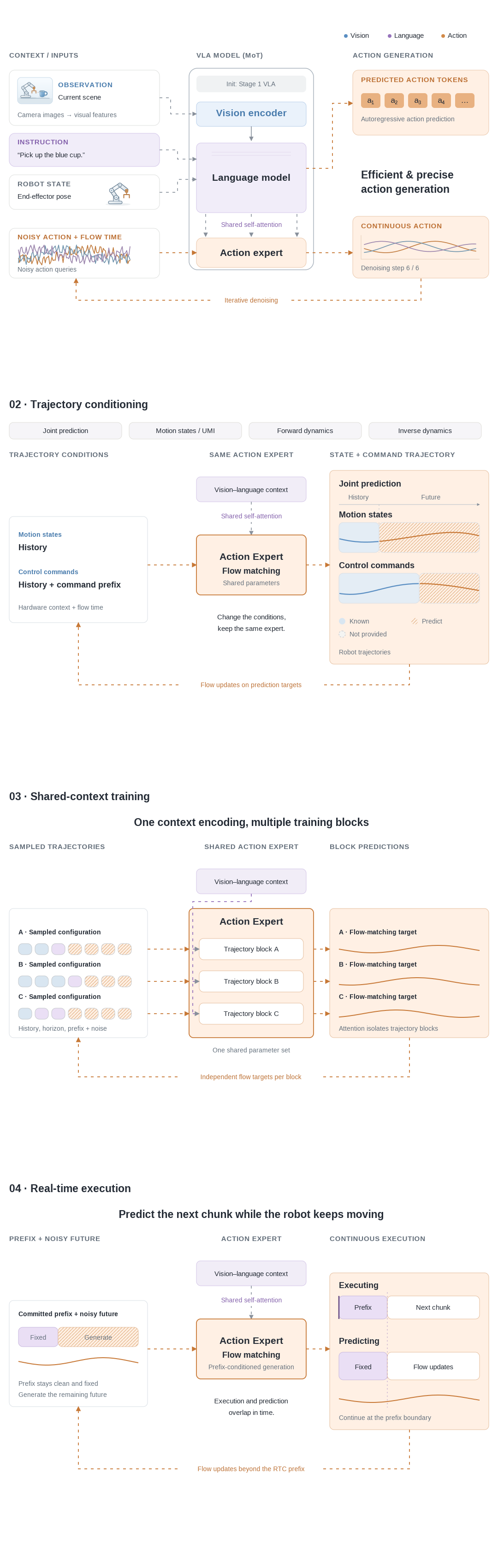
Learning from states and commands. The Action Expert represents trajectories as coupled motion-state and control-command streams, with additional conditioning on hardware context such as reference pose and control frequency. Separating states from commands lets us learn from handheld UMI trajectories through motion-state prediction, while robot trajectories also supply control-command supervision. By varying which trajectory elements serve as conditions and targets, we train state prediction, joint state-and-command prediction, and forward and inverse dynamics tasks across different history lengths and prediction horizons.
Sharing context across training configurations. We encode the vision–language context once and reuse it across multiple trajectory training blocks, each independently sampling its task, temporal configuration, action prefix, and flow noise and time. The blocks share Action Expert parameters; attention masks isolate their trajectory tokens while preserving access to the common context. This provides varied action supervision without repeating the expensive vision–language computation for every block.
Maintaining continuity during execution. At inference, the Action Expert generates action chunks through iterative flow updates. To support Real-Time Chunking (RTC)6, we train it with a variable-length prefix of future commands kept noise-free as a condition. At deployment, this prefix contains committed commands that continue executing while the model generates the rest of the next chunk, helping successive chunks follow a continuous trajectory.
Generalizable Manipulation from Diverse Experience
Precise control must be supported by manipulation experience broad enough to transfer across unfamiliar objects, environments, and task configurations. We therefore organize data collection around coverage of scenes, tasks, objects, and atomic actions, bringing complementary sources of experience into a shared training corpus. The distributions below describe this training foundation; generalization is examined in the subsequent evaluations.
We build our training corpus around diverse manipulation experience, bringing together UMI demonstrations, robot demonstrations, policy interventions, and open-source datasets. These sources provide complementary learning signals: UMI supports collection across diverse everyday environments; robot demonstrations provide action supervision for embodied execution; and policy interventions contribute challenging situations encountered during autonomous deployment. Together, these experiences support learning broad manipulation skills and translating them into physical execution on robots.
To support generalization across scenes and tasks, we organize data coverage along four dimensions: tasks, environments, objects, and manipulation behaviors. Our dataset spans 15 task categories, 32 scene categories, and 110 object categories, covering environments ranging from living rooms, bedrooms, and kitchens to workshops, offices, and laboratory workcells. The collected experience encompasses a broad spectrum of manipulation behaviors, from common pick-and-place and object transfer to more challenging interactions involving articulated mechanisms, deformable objects, ropes, and granular materials. The data landscape brings scene and task distributions into a shared view, illustrating both broad coverage and substantial long-tail variation. Semantic annotations and atomic-action tags also allow rare and contact-rich behaviors to be identified, retrieved, and up-sampled during data curation.
To scale the volume of manipulation data, we make extensive use of Universal Manipulation Interface (UMI)7, a data-collection approach that captures human manipulation demonstrations without requiring a robot on site. We implement this approach with our XRZero-G08 data-collection system, enabling large-scale collection in everyday environments. Using handheld grippers, operators demonstrate coordinated movements and contact-rich interactions, providing human manipulation experience that complements robot demonstrations. To ensure quality at scale, an automated pipeline applies more than 20 validation checks, covering inverse-kinematics feasibility, motion smoothness, high-frequency jitter and pose discontinuities, visual degradation, and 6-DoF pose accuracy. These checks filter out unreliable segments before downstream action processing and semantic annotation, producing quality-controlled UMI data for VLA pretraining.
Learning to Follow Instructions at Every Level
“Clear the table” specifies a goal, but leaves many local decisions open: which object to move first, where to place it, and what to do next. “Pick up the cup” constrains the immediate action more clearly, but says less about the overall task. Coarse-grained instructions provide broader task meaning; fine-grained instructions provide tighter local action constraints. A policy needs to connect both to the same physical experience.
This creates a supervision problem. A task-level description can apply to a long sequence of distinct movements, leaving the correspondence between language and any individual action ambiguous. Local descriptions make that correspondence clearer, but on their own provide less information about how actions contribute to a larger goal. Using only one level would leave part of this relationship implicit.
We therefore annotate trajectories at four levels: task (L3), subtask (L2), action (L1), and segment (L0). The annotations describe the same experience at different temporal scales, connecting overall goals and intermediate intentions to specific behaviors. This gives us supervision for both task meaning and local action correspondence without asking a single caption to express every level at once.
Our automated annotation pipeline uses an RL-optimized segmentation model to identify action boundaries and refine them into finer motion segments using gripper states, contact events, and motion cues. A multi-view captioning model generates descriptions at each annotation level. A video-grounded verifier checks each description against the corresponding video and returns low-confidence descriptions for revision; a global consistency pass unifies object identities across the trajectory. The pipeline processes robot demonstrations, UMI trajectories, and egocentric videos into temporally aligned language supervision.
Expanding Action Capabilities through an Agent-Driven Takeover Loop
What should we collect next? More demonstrations of skills the policy already handles offer limited guidance. Its failures are more informative: they reveal the states and subtasks where human help is still needed. We let the policy execute the portions it can handle and concentrate human correction on the portions it cannot.
The robot runs autonomously until progress stalls or execution fails. A human operator then takes over, completes the current subtask, and returns control to the policy. This collects corrections in states reached by the policy itself, including situations that a successful demonstration may never visit. The aim is to make human collection effort more useful by targeting missing skills and recovery behaviors.
For recoverable errors, a rollback mechanism allows us to collect an erroneous execution and an expert correction from the same pre-error state. The shared starting point provides a direct comparison between the two continuations: what the policy did, and how an operator corrected it. These paired experiences complement successful demonstrations with examples of how an execution can go wrong and how to recover.
An agent turns these observations into the next round of collection. It combines manipulation-skill coverage, probes of current performance boundaries, and structured failure diagnoses to guide task selection and difficulty. During collection, it dispatches tasks across robots, coordinates scene setup, monitors subtask execution, and requests human correction when needed. Human operators supply the corrective actions.
Takeover experience still requires curation. Collected trajectories pass instruction, quality, and trajectory checks before selected human-controlled segments are mixed with cleaned teleoperation data under task-balanced sampling. We feed these corrections into the broader pretraining corpus across tasks and manipulation skills. This preserves a role for broad demonstrations while directing additional collection toward gaps exposed by the current policy. After training, evaluation identifies the next set of gaps.
Through this iterative collection process, we accumulate takeover-mode trajectories across diverse tasks and manipulation skills, combining autonomous policy execution with human corrective segments. Collection covers full episodes, while the training corpus uses curated intervention segments selected through quality and trajectory checks.
Efficient and precise action generation, diverse manipulation experience, and language-grounded supervision work together to support capable physical interaction. The agent-driven takeover loop provides a way to keep extending that foundation as the model improves, directing new experience toward the boundaries of its current action capabilities.
Expanding WALL-OSS-1.0 into a Model Family
WALL-OSS-1.0 is more than a single set of model weights—it is a foundation for an extensible model family.
To make adaptation more affordable and deployment more efficient, we introduce Lite and Nano, smaller models that reduce fine-tuning costs and inference overhead for fast-paced, structured downstream workflows. To learn from experience beyond reliably action-labeled data, we introduce Gen, which uses generative learning to draw on broader sources such as egocentric human video. This opens a path to learning from rich human hand–object interactions, making it especially valuable for dexterous manipulation, where precise robot action labels are difficult to obtain. The family also provides a foundation for exploring new approaches to robot control. With AR, we investigate efficient autoregressive action generation, allowing robots to begin executing actions while subsequent actions are still being generated.
Together, these extensions turn WALL-OSS-1.0 into a growing model family—making robot learning more accessible, bringing more human experience into policy training, and opening new possibilities for how robots generate and execute actions.
WALL-OSS-1.0-Lite & WALL-OSS-1.0-Nano
We introduce WALL-OSS-1.0-Lite (4B) and WALL-OSS-1.0-Nano (2B) to extend WALL-OSS-1.0 across different adaptation and deployment budgets. Lite targets downstream tasks that require ongoing fine-tuning and iteration, reducing adaptation costs through a smaller model size; Nano further reduces model size for deployment with more limited compute resources. To meet the efficiency goals of these two models, we combine smaller model sizes with inference serving and hardware execution optimizations, reducing costs from task adaptation to operation.
In evaluations based on real-world production deployment scenarios9, WALL-OSS-1.0-Nano supports 18 robots on a single Blackwell consumer GPU. This result is supported by both model size and inference system optimizations: our VLA serving framework XInfer10 is designed for high concurrency, low latency, and low cost, using efficient cross-robot scheduling and optimized inference execution to translate the compute advantages of a smaller model into practical capacity for serving multiple robots. For on-device deployment, we further optimize inference execution across the WALL-OSS-1.0 model family through hardware–software co-design on heterogeneous platforms, including NVIDIA Jetson Thor and Huixi on-device ASICs. Specifically, we use cycle-level GPU simulation11 to accelerate inference kernel development, combined with DSL-based kernel optimization to improve performance and portability across hardware architectures and support efficient model deployment from the cloud to onboard devices.
WALL-OSS-1.0-Gen
Egocentric (ego) video captures human hands using tools, manipulating objects, and coordinating complex interactions across many settings. But seeing a movement does not guarantee a reliable robot action label. Visual estimation and retargeting can introduce errors, especially for hands with many degrees of freedom. The challenge is to learn from this broad experience while accounting for the uncertainty in its action labels.
WALL-OSS-1.0 trains its action policy to predict robot actions, which requires reliable action labels. Robot trajectories and aligned UMI data provide this supervision, but action labels derived from ego video can be noisy in some dimensions, and captioned video may have none at all. The action-prediction objective alone cannot effectively learn from these sources when reliable action targets are unavailable. We introduce generative supervision over actions and future visual states, routed according to data quality, so that these sources can contribute even when precise action labels are unavailable.
WALL-OSS-1.0-Gen retains the shared VLM and Action Expert and adds a Generation Expert connected to WAM, an external generative model used only during training. The Action Expert learns policies from precise robot trajectories and UMI data. The generative branch learns actions and future visual states from robot trajectories and broader sources such as ego data; video without action labels contributes through visual prediction. This lets video supply a learning signal even when precise action supervision is unavailable.
Generative supervision updates the VLM and Generation Expert through backpropagation, providing a route for broader experience to shape the representations available to the action policy. At inference, the VLM and both experts are retained, without running WAM. Precise robot and UMI trajectories remain the source of direct policy supervision; the generative branch provides an additional way to learn from less reliably action-labeled experience.
We use Gen to train high-degree-of-freedom dexterous hands, drawing on ego video to broaden the scenes and interactions represented in training. The examples below show tool use, component manipulation, and bimanual unpacking after training with ego data.
WALL-OSS-1.0-AR
WALL-OSS-1.0-AR is a vision–language–action model designed for efficient autoregressive inference. Inference speed and action precision have long been bottlenecks for autoregressive VLAs: compact action codes can lose motion detail, while longer sequences increase generation latency. WALL-OSS-1.0-AR starts from the weights produced by Stage 1 native vision–language–action pretraining and extends them for direct autoregressive action generation. It combines high-fidelity action tokenization with incremental decoding and real-time chunking (RTC)6, allowing the robot to begin executing actions while subsequent actions are still being generated.
A high-fidelity action tokenizer combines temporal compression with hierarchical residual coding to preserve fine motion detail in compact sequences, while its MaT interface accommodates different robot control layouts. The model predicts these codes autoregressively and decodes them directly into continuous commands, without a separate flow or diffusion action expert. To make actions available sooner, generation proceeds in time-major order: once all residual codes for a temporal segment are complete, a causal decoder reconstructs that segment, and RTC allows execution to begin while subsequent segments are still being generated. Separate caches in the model and action decoder reduce repeated computation, combining fewer prediction steps with overlapping generation, decoding, and execution.
Strong Performance Across Benchmarks
We evaluate reasoning, task understanding, and manipulation in real-robot trials and simulation. The following sections describe the protocols, baseline comparisons, and results for each setting.
Internal Real-Robot Evaluation
How much real-world capability does pretraining deliver on its own? We evaluate a single pretrained WALL-OSS-1.0 policy directly on real robots, with no task-specific fine-tuning in either evaluation. We first measure its performance against prior baselines on a fixed benchmark, then examine the breadth of its capabilities through open-ended tasks freely selected by evaluators.
We begin with the 15 tabletop tasks in ManipArena12, covering physical execution and semantic understanding. Each task includes 10 real-robot trials with visual variation and held-out objects; scores capture partial task progress as well as full completion. Both WALL-OSS-1.0 and WALL-OSS-0.5 are evaluated directly after pretraining, with no subsequent fine-tuning, while the π0.513 baseline is multi-task fine-tuned. These comparisons measure progress over the previous WALL-OSS model and performance relative to a fine-tuned baseline under the same evaluation protocol.
WALL-OSS-1.0 achieves 1,101/1,500 points—52.5% above WALL-OSS-0.5 and 70.8% above the fine-tuned π0.5 baseline. It leads or ties for the highest score on 14 of 15 tasks, with the highest aggregate score in both execution and semantic tasks. Overall success reaches 50.67%, up from 19.33% for WALL-OSS-0.5 and 24.0% for π0.5. These results show a substantial gain in the capability available directly from the pretrained model.
Score per task / 100 · 10 real-robot trials each
Put spoon in bowl
Pick items into basket
Put blocks on matching colors
Put glasses on shelf
Put ring onto rod
Plug in power cord
Put items into drawers
Arrange cups in inverted triangle
Pour water from bottle
Put stationery in pencil case
Sort headphones
Pair up items
Pick fruits into basket
Classify items by shape
Press buttons in order
The gains are especially pronounced in tasks that require understanding what to manipulate and how objects relate. Semantic-task success rises to 78%, compared with 20% for WALL-OSS-0.5 and 44% for π0.5. WALL-OSS-1.0 completes every trial of headphone sorting, object pairing, and fruit selection into a basket—three tasks that combine semantic decisions with physical execution. Execution also improves across all 10 manipulation tasks relative to WALL-OSS-0.5. Water-pouring scores rise from 6 to 46, and power-cord insertion from 21 to 62.
ManipArena establishes performance on a fixed set of tasks. To examine how broadly the same pretrained policy can be used beyond this set, we next conduct an open-ended zero-shot evaluation, in which evaluators freely select real-robot manipulation tasks. The policy is again deployed directly, without task-specific fine-tuning.
Across 377 evaluations, averaging results for identical task instructions yields 312 unique tasks, organized into 47 canonical task clusters across 8 task families and 9 capability dimensions. This broader task set covers multi-step sequential execution, pick-and-place, bimanual coordination, stability and protection constraints, container placement and stacking, occlusion handling, spatial relations, tool use, and deformable/articulated manipulation.
WALL-OSS-1.0 achieves an overall mean score of 6.45 / 10 (64.5 / 100) and a 55.1% zero-shot success rate. Multi-step sequential execution reaches 7.40/10 with 66.5% success, pick-and-place reaches 7.00/10 with 62.2% success, and bimanual coordination reaches 6.67/10 with 57.7% success. The radar chart below shows performance across capability dimensions; expand the detailed task table beneath it to explore task clusters and individual instructions. These results describe capability coverage across the freely selected tasks; their aggregate rates are separate from the ManipArena comparison because the task sets and evaluation protocols differ.
Internal Simulation Evaluation
The real-robot evaluation tests what WALL-OSS-1.0 can do directly after pretraining. We next use X2Real14 to examine performance after fine-tuning on simulation data. X2Real contains over 40 tasks spanning reasoning and manipulation, with extensive domain randomization and evaluation environments held out from training. Unlike the real-robot evaluation above, all participating models except GPT-6-Astra15 are fine-tuned for one epoch on simulation data.
WALL-OSS-1.0 achieves the highest overall score among the evaluated models: 67.55, a 65.0% improvement over Lingbot-VLA-2.016, the strongest other open-source baseline at 40.94. It also leads in both score components, reaching 34.68 in Reasoning + Manipulation and 32.87 in Pure Manipulation, each scored out of 50. Its Pure Manipulation score exceeds GPT-6-Astra’s 21.48 by 53.1%, highlighting its strength on the benchmark’s physical execution tasks.
Additional baselines shown in the comparison include DM0.517, DreamZero18, and OpenWAM-A.
We then extend the evaluation from tabletop tasks to mobile manipulation. These tasks require the robot to coordinate base movement with grasping and placement, connecting actions across different locations. This adds a practical challenge: carrying manipulation capability beyond a fixed workspace.
Across all three mobile manipulation tasks under out-of-distribution (OOD) conditions, WALL-OSS-1.0 outperforms π0.5. Its mean OOD score reaches 44.17, compared with 24.83 for π0.5—a relative improvement of 77.9%. On the bottle-to-shelf task, the score rises from 19 to 42.5, more than doubling the baseline. The consistent gains across the three tasks provide further evidence of generalization within these mobile manipulation settings.
See the X2Real technical report19 for further evaluation details.
Public Simulation Leaderboard
Beyond our internal evaluations, public benchmarks provide a shared setting for comparing policies across a broader range of manipulation challenges. We evaluate WALL-OSS-1.0-Lite on RoboDojo20, which comprises 42 simulation tasks across five dimensions: generalization, precision, long-horizon execution, memory, and open-ended manipulation.
WALL-OSS-1.0-Lite ranks first among policies without agent systems on the simulation track of the official leaderboard21 as of November 5, 2026, with an overall score of 42.59. In this snapshot, it exceeds the next entry by 3.33 points and achieves the highest scores in both generalization settings and memory. These results complement the internal evaluations with a comparison against other policies on a public benchmark.
RoboDojo / Top 5 · Policies without agent systems
| Rank | Model | Overall | Generalization | Precision | Long- horizon | Memory | Open | |
|---|---|---|---|---|---|---|---|---|
| Standard | Random | |||||||
| 01 | WALL-OSS-1.0-Lite | 42.59 | 53.44 | 39.88 | 38.16 | 49.94 | 57.42 | 20.76 |
| 02 | VPP2 | 39.26 | 52.14 | 20.63 | 43.03 | 56.28 | 56.01 | 4.61 |
| 03 | Awomo-0.5 | 35.34 | 37.70 | 22.92 | 39.65 | 40.36 | 42.27 | 24.09 |
| 04 | Simate-beta | 33.95 | 40.54 | 29.63 | 34.35 | 57.84 | 33.33 | 9.12 |
| 05 | Rex-M1 Preview | 33.79 | 42.64 | 25.46 | 32.82 | 46.89 | 48.53 | 6.67 |
Some RoboDojo tasks require memory, particularly over long horizons. Rather than modifying the architecture to add memory, we let the model assess task progress, select keyframes, and use them to guide subsequent actions. Strong performance on these memory-dependent tasks highlights how general understanding can support downstream manipulation.
From Benchmarks to Real-World Impact
Beyond benchmarks, we explore how WALL-OSS-1.0 supports real-world applications: efficient adaptation for production parcel sorting, and language-guided execution for long-horizon tasks. These cases highlight how its pretrained capabilities support both specialized deployment and flexible coordination with high-level policies.
WALL-OSS-1.0 in Production: Parcel Sorting
We examine this through parcel sorting for a leading logistics customer, using WALL-OSS-1.0 as the foundation for a task-specific policy. Parcel sorting requires correct barcode orientation, aligned edges, and individual parcel feeding within a tight operating cycle. The deployed policy must also handle interruptions, including reprocessing parcels to help resume sorting. WALL-OSS-1.0 reduces task data requirements by roughly two orders of magnitude. Fine-tuning from the pretrained model takes approximately 10 hours of task data to reach a usable level, compared with more than 1,000 hours without pretraining.
The adapted policy also transfers across production sites. Despite changes in lighting, tables, conveyors, and parcel distributions, the WALL-OSS-1.0-based policy retains more than 90% of its original-site sorting speed and success rate in our cross-site comparison. The policy trained without pretraining sees its success rate drop by more than 90%.
Kernel optimization and quantization provide more than a 4× inference speedup for WALL-OSS-1.0 in our deployment setup, while shared serving allows a single GPU to support multiple robots. Failure cases from deployment guide subsequent training through rollout analysis and curated corrective experience, with these lessons feeding back into the broader pretraining pipeline.
WALL-OSS-1.0 as a Language-Guided Foundation for Long-Horizon Tasks
WALL-OSS-1.0 turns language instructions and visual observations into robot actions. A high-level planner can guide the same model through a multi-step task by updating its instructions as the scene changes.
Training with task-, subtask-, action-, and segment-level annotations supports this interface. These annotations connect broad goals with specific objects, destinations, and motion constraints, helping the model follow instructions at different levels of detail.
We built XR Harness22 to coordinate long-horizon tasks around WALL-OSS-1.0. System 2 plans and revises task steps using observations and execution feedback. System 1 uses WALL-OSS-1.0 to execute each step, with completion checks and scene updates. System 0 connects the framework to robot controllers and sensors through the Robot Agent Protocol (RAP).
The following three cases highlight complementary demands on language-guided manipulation: executing successive instructions, translating abstract requests into concrete actions, and replanning in response to execution feedback.
Case 1: Tabletop cleanup — successive instruction following
Given “Clean up the table,” XR Harness organizes the task into collecting fruit, organizing small objects, and stacking plates. WALL-OSS-1.0 executes the successive instructions as the scene changes, grounding object references such as “the remaining black binder clip” and placement constraints such as stacking the orange plate while keeping the white plate in place. The sequence illustrates how a shared execution model supports different objects, destinations, and local constraints throughout a longer task.
Case 2: Find the message — from an abstract request to concrete actions
The user gives an abstract request: “Find the message on the table and follow it.” The information needed to act is initially hidden beneath objects, so the robot must manipulate the scene to uncover it. It then interprets the revealed “apple → basket” drawing and translates the user’s intent into a concrete action: placing the apple in the basket.
Case 3: Cup-tower detour — feedback-driven replanning
The user asks the robot to place the marker on the plate without disturbing the cup tower. When the system determines that the transfer cannot be completed via the far side of the table, it revises the route and issues new instructions to guide the model around the near side, then complete the handoff and placement. This case illustrates how execution feedback informs replanning, guiding the same model toward task completion.
A Scalable Path Toward More Capable VLA
WALL-OSS-1.0 marks a milestone on our path toward general-purpose embodied intelligence. Beyond its performance today, we see lasting value in the research paradigm behind it and the directions it opens for continued progress. Building on native VLA training, we aim to deepen the intelligence to understand the world by scaling unified pretraining, enriching multimodal supervision, and grounding understanding in physical experience. We aim to strengthen the ability to interact with it effectively through broader robot experience, precise and efficient execution, and adaptive closed-loop control. Progress along both dimensions defines our research path from WALL-OSS-1.0 toward more capable models.
Our goal is to advance both capabilities together, so that richer understanding supports more capable action, and broader physical experience grounds the model’s understanding of the world. WALL-OSS-1.0 is a step along this path. The longer-term ambition remains the one we began with: a single pretrained model that can enter an unfamiliar environment, understand a new instruction, and act effectively without task-specific demonstrations or fine-tuning. We see this as the promise of VLA pretraining, and the direction that will guide our work beyond WALL-OSS-1.0.
Citation
Please cite this work as:
X Square Robot Team. “WALL-OSS-1.0: Understand More, Act Better.” X Square Robot Blog, November 23, 2026. https://x2robot.com/blogs/wall-oss-1/
@misc{x2robot2026walloss1,
  author = {{X Square Robot Team}},
  title = {{WALL-OSS-1.0: Understand More, Act Better}},
  year = {2026},
  howpublished = {X Square Robot Blog},
  url = {https://x2robot.com/blogs/wall-oss-1/}
}