Model Introduction
Learn about Wall-OSS-0.5's positioning, co-training framework, action representation, pre-training data, and real-robot evaluation results.
Wall-OSS-0.5 is an open-source vision-language-action (VLA) model released by X Square Robot, designed to develop general manipulation capabilities for real-robot scenarios.
Model development paths
Developers can start from three paths:
-
Directly validate the pre-trained model: without retraining, complete input/output configuration, inference service setup, and real-robot validation.
-
Fine-tune Wall-OSS: Fine-tune the model using custom LeRobot-format data, and then perform evaluation and real-robot execution.
-
Adapt third-party models: Complete observation, action, data, training, and SDK execution pipeline adaptation; this section provides instructions for π0.5 adaptation.
From pre-training to direct deployment
Wall-OSS-0.5 is built upon a 3B vision-language model backbone, with an overall size of approximately 4B parameters. Based on visual inputs and language instructions, the model directly generates continuous actions that can be executed by real robots.
Traditional robot models typically require task-specific fine-tuning to fully realize their capabilities. Wall-OSS-0.5 places greater emphasis on executable capabilities formed during the pre-training phase: even without task-specific fine-tuning, the pre-trained checkpoint can demonstrate measurable manipulation performance in real-robot tasks.
The core goal of Wall-OSS-0.5 is to advance robot foundation models from "better initialization" toward "directly verifiable pre-trained capabilities." In language and vision domains, pre-trained models are typically able to directly answer questions, understand images, or follow instructions; Wall-OSS-0.5 redesigns the VLA pre-training process around this gap in robotics, enabling the pre-trained checkpoint itself to be evaluated as a real-robot policy.
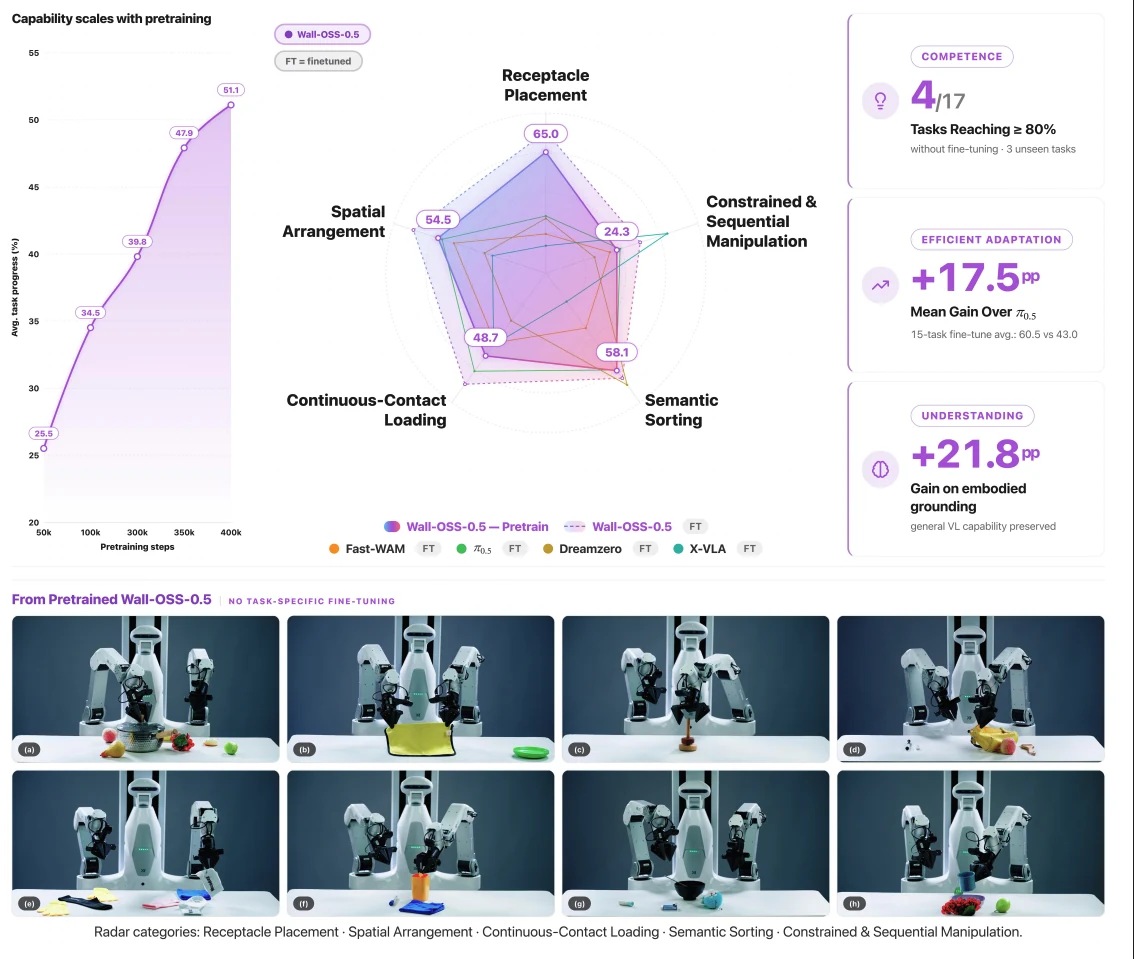
Wall-OSS-0.5 pre-trained capabilities and embodied understanding performance
Gradient-bridged co-training
Wall-OSS-0.5 adopts the gradient-bridged co-training framework, combining three complementary objectives:
-
Multimodal Cross-Entropy: Maintains the vision-language model's original instruction understanding and visual grounding capabilities;
-
Discrete Action Token Prediction: Acts as a "gradient bridge" to inject control-related signals into the vision-language backbone;
-
Continuous action flow matching: Serves as the action generation interface during deployment, outputting continuous actions executable by real robots.
Through this design, the model can simultaneously learn to "perceive scenes," "understand instructions," and "generate actions" within a unified training system.
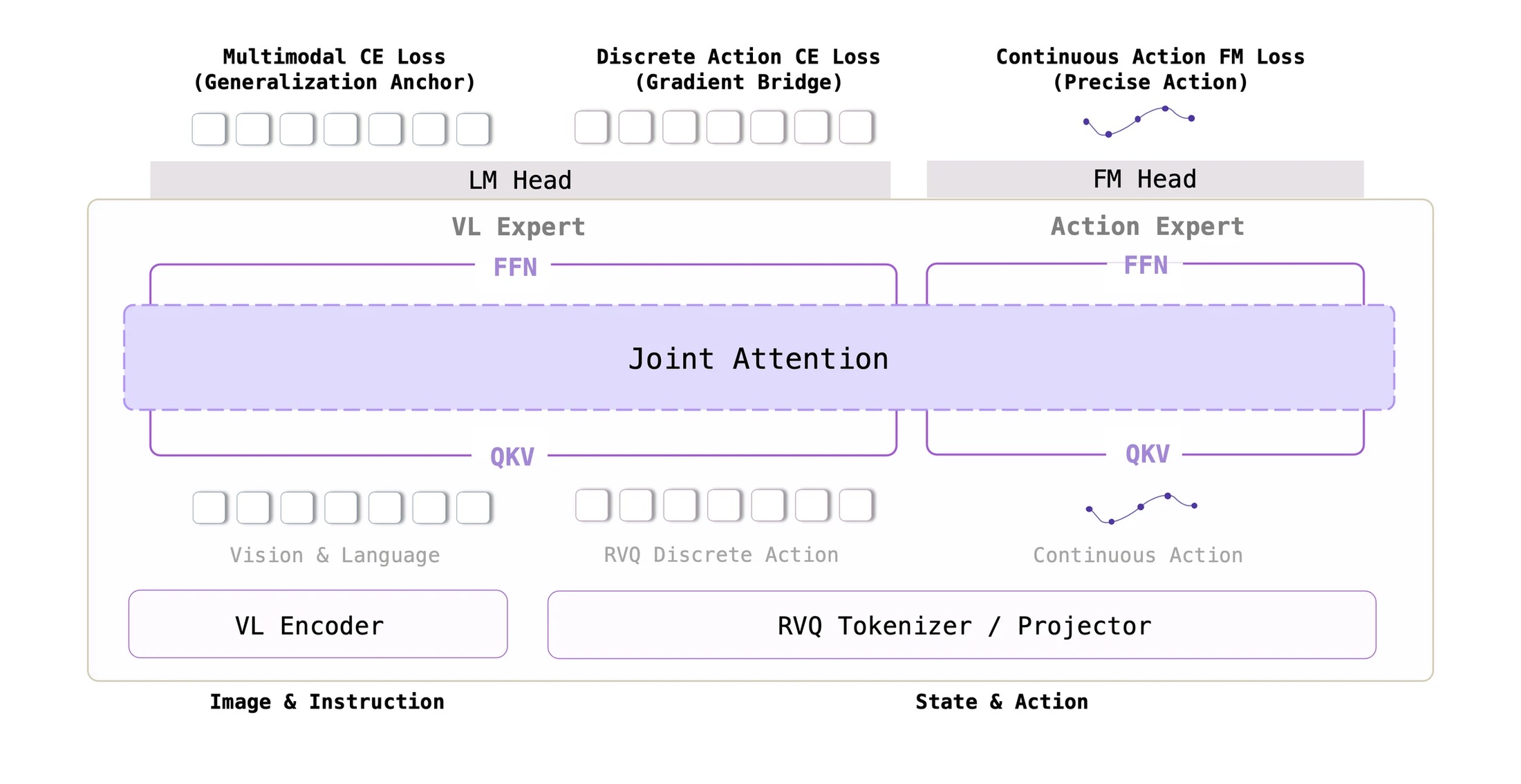
Wall-OSS-0.5 gradient-bridged co-training architecture
Vision-aligned action representation
Wall-OSS-0.5 introduces the Vision-Aligned RVQ Action Tokenizer. Rather than merely compressing action trajectories into discrete tokens, it also leverages objectives such as vision-action alignment, future observation prediction, and action reconstruction to enable discrete action tokens to better convey manipulation semantics learnable by the vision-language backbone.
During the training phase, the discrete action path primarily provides strong supervision signals, while during the deployment phase, the continuous action path outputs real robot actions.
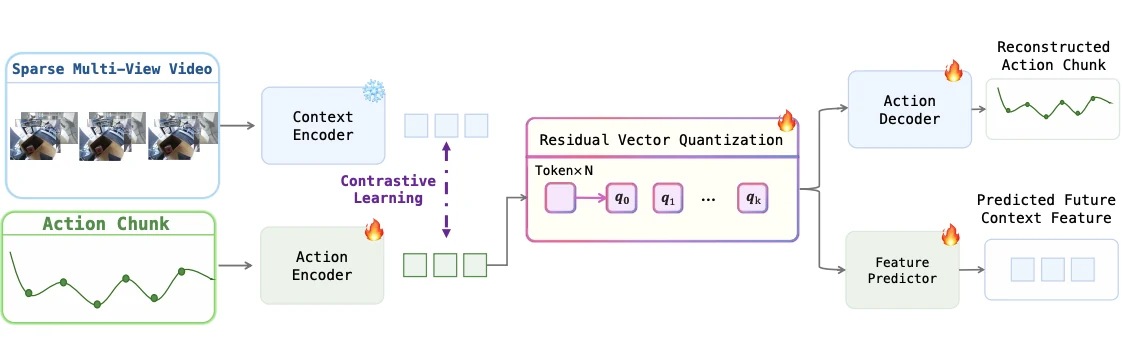
Vision-Aligned RVQ Action Tokenizer structure
Pre-training data
Wall-OSS-0.5's pre-training data combines:
-
High-quality self-collected robot manipulation data;
-
Curated open-source multi-robot embodiment data;
-
Large-scale multimodal corpora;
-
Embodied bridge data constructed from robot action trajectories, used to connect visual understanding, spatial reasoning, and executable actions.
The model pre-training covers more than 20 robot embodiments, processing over 1 million robot trajectories per epoch and incorporating approximately 90 million multimodal samples.
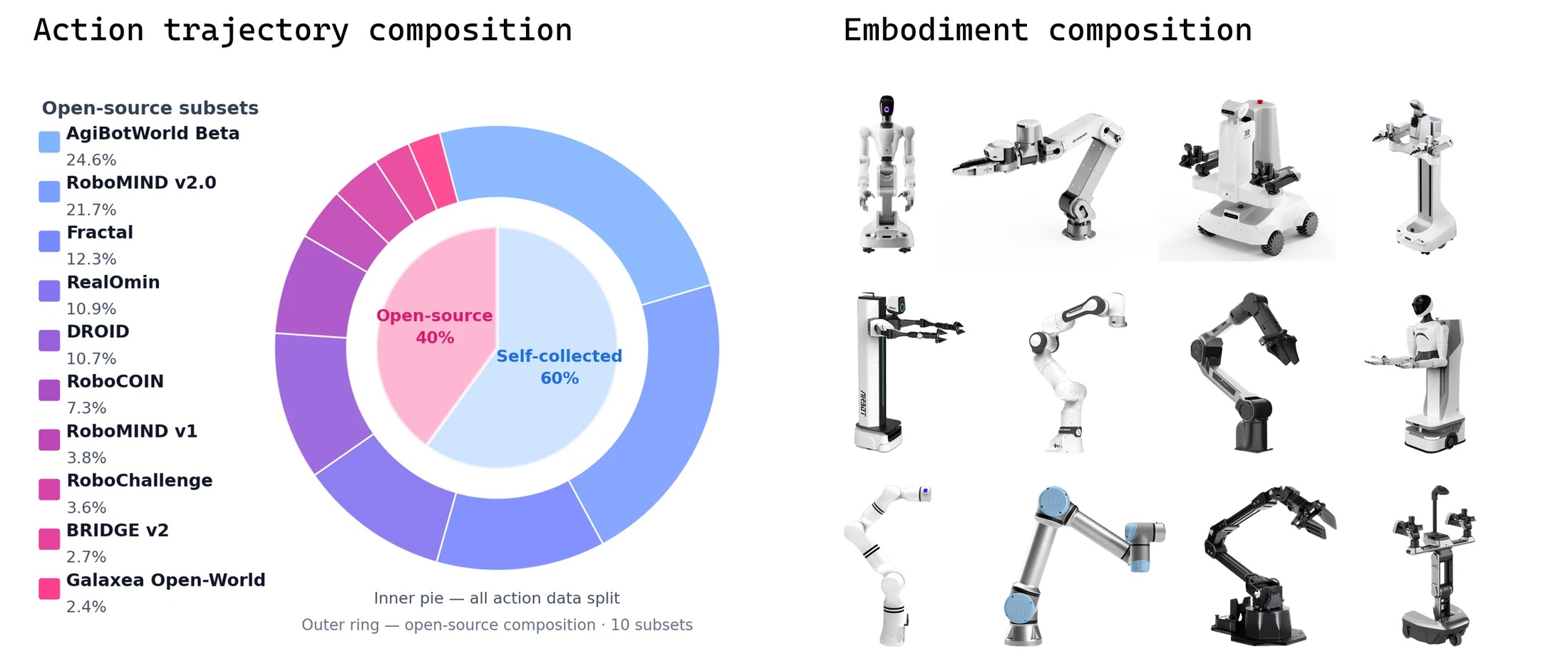
Wall-OSS-0.5 pre-training data composition and robot embodiments
Real robot capabilities
Wall-OSS-0.5 underwent direct evaluation of pre-trained checkpoints on 17 real robot tasks, covering semantic understanding, rigid-body manipulation, deformable object manipulation, fine manipulation, and long-horizon multi-step manipulation.
At the 400k-step checkpoint:
-
The overall average task progress reaches 51.1;
-
The average for seen tasks is 50.0, and the average for unseen tasks is 53.6;
-
Block Sorting reaches 100%;
-
Fruit Sorting reaches 96%;
-
Ring Stacking reaches 86%;
-
The unseen deformable object task Rope Tightening reaches 82%.
In fine-tuning across 15 real robot downstream tasks, the average task progress of Wall-OSS-0.5 reached 60.5, outperforming π0.5 (43.0) and DreamZero (33.4) reported in the source material. These results demonstrate that deployment-oriented pre-training can both establish direct execution capabilities and provide stronger capability priors for subsequent fine-tuning.
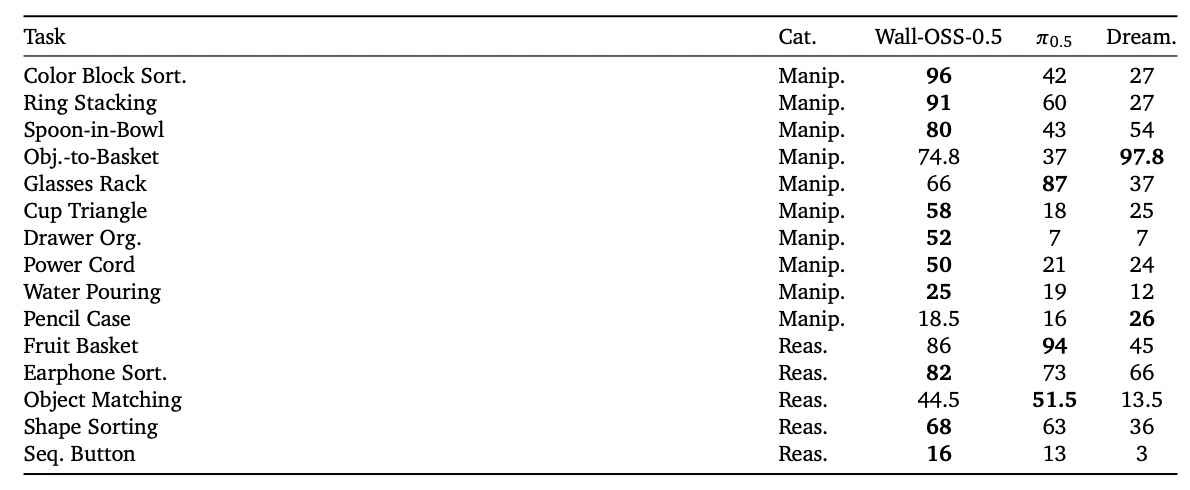
Wall-OSS-0.5 real robot task evaluation results
Embodied understanding capability
Action data and embodied multimodal data not only help the model learn control, but also strengthen its understanding of key questions such as "where can the robot act," "where is the target," and "where should the object be placed."
Compared to the original vision-language backbone, the improvements reported in the source material include:
-
Embodied Grounding: improved by 21.8;
-
Where2Place placement reasoning: improved by 11.0;
-
EO-Bench: improved by 3.9.
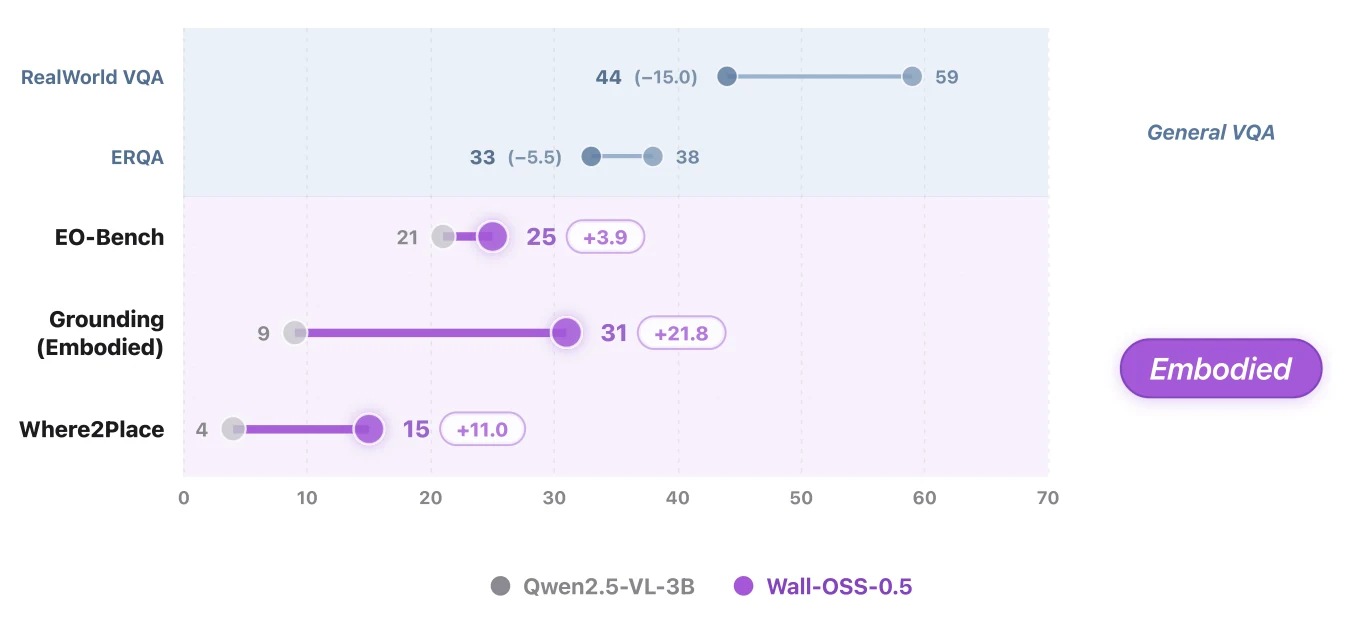
Wall-OSS-0.5 embodied understanding benchmark results
The above results are intended to demonstrate model capabilities and do not constitute a performance commitment for specific user tasks. Actual results depend on robot configuration, data quality, task distribution, training configuration, and the real-robot environment.
Open source and version scope
Wall-OSS-0.5 aims to provide the embodied AI community with a foundational platform for research that is reproducible and extensible, helping move robot foundation models from laboratory evaluation to real-world deployment.
This document applies only to Wall-OSS-0.5. When using Wall-OSS-FLOW or Wall-OSS-FAST, switch to the corresponding historical code:
git checkout 97406f2ab5de414c79b091873f946c112d105c72